Supervisor Training
April 2026 – April 2027
The purpose of this programme is to train, qualify and accredit coach supervisors.
Audience
The course has been developed for experienced coaches, operating at the level of Senior Practitioner (with EMCC Global or AC), PCC (with ICF), Level 5 (with ILM) or any other equivalent accreditation status.
Accreditation
Successful completion of the programme includes meeting all the EMCC Global training requirements for individual accreditation as a supervisor.
If they have accumulated sufficient practice hours, graduates will obtain the internationally recognised ESIA supervisor accreditation with EMCC Global.
The course fee includes the cost of accreditation.
Process
We apply an experiential learning approach combining taught input, reflection and dialogue, practice in a safe environment, detailed feedback, and experimentation with live clients.
Course Overview
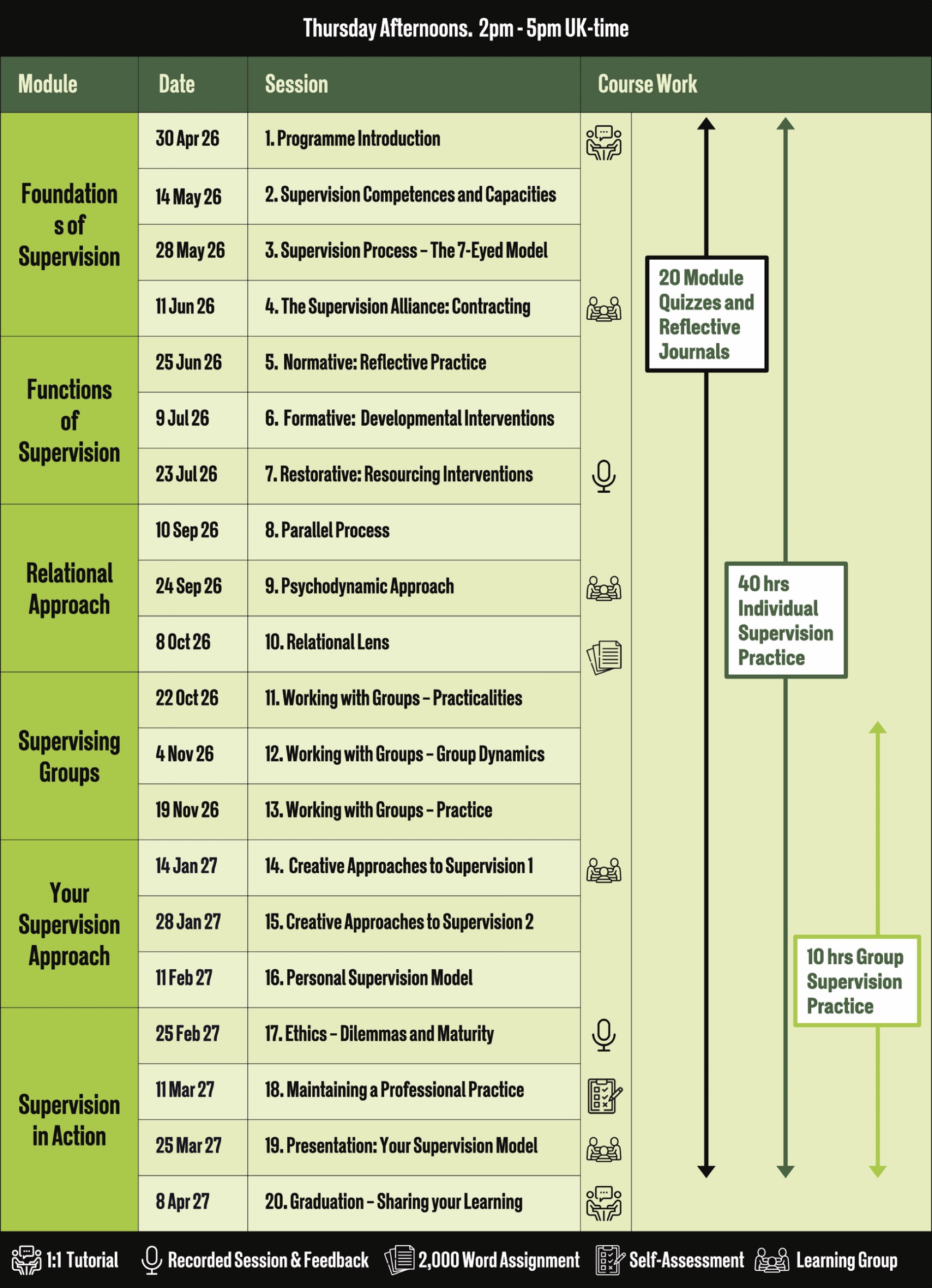
Course Timings
We have designed this programme to align well with the life of a busy professional. Training sessions are short and well-spaced over 12 months. We have chosen dates to avoid school holidays.
Course Components
The programme is focused around 20 live, virtual training sessions.
In addition to their ongoing practice, participants will maintain a learning journal, attend four facilitated reflective learning group sessions, submit and receive feedback on two recorded supervision sessions, participate in the online group discussion, write a 2000-word essay, review the essays of their learning group members, and carry out a final self-assessment exercise.
Learners will also begin and end the course with a 1:1 tutorial with course faculty. NB: course design subject to change and adjustment over time – advertised content and process may be different from actual delivery.
The Course at a Glance
20 live training sessions
4 facilitated learning sets
1:1 group supervision practice
Online learning environment
2 × feedback on a recorded session
Ongoing reflective journal
2,000 word assignment
Assessment and accreditation
The Bigger Picture
Supervision is safe space for reflective dialogue with a practicing supervisor, supporting the supervisee’s practice,
development, and well-being.
MODULE 1
FOUNDATIONS OF SUPERVISION
Learners will discover the basics of supervision. Learning groups will be established and will meet for the first time. Individuals will also pair up with each other to form practice supervision pairs and will start supervising each other in their own time. Reflective Journals will start and learners will contribute to the online community discussion forum.
SESSION
1
Programme Introduction
Overview. What to expect. Introductions. Course contract. Learning Platform.
- 1:1 Tutorial
SESSION
2
Supervision Competences and Capacities
Defining Supervision. Working with the Supervision Competence Framework.
SESSION
3
Working with The 7-Eyed Model
Demonstration. Applying the 7-Eyed supervision model. Introduction to Parallel Process.
SESSION
4
The Supervision Alliance: Contracting
Establishing a working alliance between supervisor and supervisee.
MODULE 2
FUNCTIONS OF SUPERVISION
This module contains three sessions and a recorded supervision exercise. We introduce Proctor’s three functions of supervision: Normative, Formative and Restorative. The intention is to establish and embed essential supervision skills by the end of the first term, so that learners are set up for success.
SESSION
5
Normative: Reflective Practice
We explore what it means to be an effective reflective (and reflexive) practitioner.
SESSION
6
The Relational Approach to Supervision
How the supervisor supports the supervisee to improve their competence as a coach.
SESSION
7
Restorative: Resourcing Interventions
How the supervisor supports the supervisee to resource themselves, remaining fit to practice.
- Recorded Session & Feedback
Recorded Session
During Module 2, learners will record one of their supervision sessions.
Learners will provide feedback to each other on their recorded sessions.
Written feedback will be provided by a member of faculty.
Learners will collect feedback and use this to inform their ongoing learning objectives .
2000 Word Assignment
At the end of this module we introduce the 2000 word essay. This is a reflective exercise in which learners consider their supervision journey so far and consolidate their thoughts.
Social learning is an important aspect of this course. Learners will meet informally, in small groups to present and discuss their work.
MODULE 3
THE RELATIONAL APPROACH
Having established basic supervision skills, we take a deeper dive into the psychological dimension of our work as supervisors. Our practice is rooted in the ‘relational approach’, drawing on psychodynamic theory and humanism. These sessions introduce essential knowledge for competent practitioners of supervision, and provide opportunities to apply it.
SESSION
8
Parallel Process
Noticing, understanding and working explicitly with ‘parallel ‘process’.
SESSION
9
Psychodynamic Approach
Defence mechanisms, transference, counter- transference, projection, projective identification.
SESSION
10
The Relational Lens
Understanding Social Constructionism and a narrative interpretation of the self.
- 2,000 Word Assignment
MODULE 4
SUPERVISING GROUPS
We dedicate an entire module to the practice of supervising groups. This is a more sophisticated and complex practice requiring skills that go beyond supervision.
We provide opportunities for learners to explore a role that combines pure supervision, facilitation of group dynamics, managing a process, and harnessing the collective intelligence of the members of the group.
SESSION
11
Groups: Practicalities
Creating the container and holding the space for groups of supervisees.
SESSION
12
Groups: Interpersonal Dynamics
Managing complex group dynamics and ensuring all group members benefit equally.
SESSION
13
Groups: Practice and Feedback
Taking risks, listening, valuing different perspectives, having real conversations.
Progress Update
Since Session 1, learners have accumulated at least twenty hours of 1:1 supervision experience and are developing their personal style.
They have completed two facilitated reflective learning group meetings, provided feedback to each other on a recorded supervision session and are working on their 2000 word consolidation essays.
Learners have also submitted 10 reflective journal entries and participated in the online discussion forum.
MODULE 5
YOUR SUPERVISION APPROACH
At this stage in the programme, learners are encouraged to experiment and stretch the boundaries of their practice as supervisors. We introduce creative approaches to supervision and invite learners to identify ways of working that are authentic and unique to them. They may discuss this in their third reflective learning group, which takes place now.
SESSION
14
Creative Approaches to Supervision 1
An enquiry into freedom, stuckness, spontaneity and not-knowing. Working ‘live’.
SESSION
15
Creative Approaches to Supervision 2
Practicing and experimenting with working in a creative way. Working ‘live’.
SESSION
16
Introduction: Your Supervision Model?
Developing an individualised model of supervision and applying it authentically.
MODULE 6
SUPERVISION IN ACTION
During the final module learners will be preparing for graduation and their future practice as qualified supervisors. Learners will start collecting feedback from their supervisees and complete a process of personal self-assessment against the learning outcomes, with reference to the EMCC Supervision Competence Framework.
Learners will also complete their fourth and final reflective learning group session during this period.
SESSION
17
Ethical Dilemmas in Supervision
Exploring ethical dilemmas and developing ethical maturity as practitioners. Practical Exercise.
- Recorded Session & Feedback
SESSION
18
Maintaining a Professional Practice
Best practice for CPD, supervision, reflective practice, ethics, record keeping and more.
- Self Assessment
SESSION
19
Presentation of Personal Supervision Model
Learners will share their personal supervision models with other cohort members.
SESSION
20
Graduation
Sharing overall learning and personal outcomes from 12-month journey.
Recorded Session 2
During Module 6, learners will record another supervision session.
This will be reviewed by faculty and will play a part in the overall assessment of candidates, resulting in their graduation from the programme, and accreditation with EMCC Global.
COURSE COMPLETION
Assessment
Assessment is not based on a pass or fail approach. Our method is to support learners to develop, at their own pace and in their own way to achieve a successful outcome.
Attendance
It is essential that learners attend a minimum of 80% of all sessions (taught modules and learning group sessions). If sessions are missed, these need to be made up for by listening to the recording of the session and carrying out a small amount of additional homework.
Total Qualification Time:
We estimate that this programme will take a minimum of 150 hours of learner time. Individuals may choose to spend longer than this, exploring areas of interest, or collecting additional practice hours.
| 20 x 2.5hr Zoom Modules | 50 hours |
| 1:1 Supervision Practice | 40 hours |
| Groups Supervision Practice | 10 hours |
| Homework | 50 hours |
| Total (maximum estimate) | 150 hours |
Accreditation Criteria
1. Successful completion o f the programme
2. Membership of EMCC Global (150 Euros/year)
3. Minimum of 120 supervision practice hours
4. Minimum of 10 Supervisees

ONLINE LEARNING PLATFORM
We use world-class online learning platform which acts as a secure base for all the work that we do over the 12-month period.
All the handouts contained within the programme will be available here, along with homework assignments and space for community discussion.
The platform acts as a container for the learning journey undertaken by participants.
Each module gets unlocked at the right time, and all learner requirements are made
clear and visible.
Progress is indicated visually, and overdue tasks are highlighted.
Each module has a Community Discussion area where participants will share resources and reflections. Sessions are also followed up with a mini quiz.
The reflective journal activity is an important part of the process: during the second half of the programme, we encourage social learning by partnering participants with each other to review each other’s reflections.

for more information, and to book onto the Diploma in Coaching Supervision, please contact support@governmentcampus.co.uk